Welcome To Part 9 Of Our Series: BUILT BY HAND: A BEGINNERS GUIDE TO HAND TOOLS
Sharpening Without the Mystery
More beginners give up on hand tools because of sharpening than for any other reason. They struggle to get a plane taking clean shavings or a chisel cutting crisply, and they conclude that the tools are the problem. Usually, the tools are fine — the edges are just dull.
Sharpening is not complicated. It takes some practice to develop the technique, but the principles are straightforward. Here’s what you need to know.
Why Sharp Matters
A truly sharp edge does things that a merely serviceable edge can’t. It slices wood cleanly instead of tearing it. It requires less force, which gives you more control. It leaves a surface that looks better and needs less cleanup. And sharp tools are safer — dull tools require more force and are more likely to slip.
The test for sharpness is simple: drag the edge lightly across the back of your thumbnail. A sharp edge catches; a dull edge skates off. Another test is to hold the edge up to a light — a sharp edge has no bright reflection because there’s no flat surface on it. Any flat spots mean dullness.
What You Need
You don’t need a lot of equipment to sharpen chisels and plane irons. A medium-grit sharpening stone and a fine-grit sharpening stone are the core requirements. You can start with a combination stone that has both grits on opposite faces — it’s economical and does the job.
The two main types are oilstones (lubricated with a light oil) and waterstones (lubricated with water). Waterstones cut faster and are popular in many shops. Oilstones are slower but durable and need less maintenance. Either type works well. Pick one and get used to it.
A leather strop — a thick strip of leather, optionally dressed with stropping compound — is the final step. Stropping removes the last burr and polishes the edge to its final sharpness. It’s a quick step that makes a meaningful difference.
The Two Surfaces You’re Sharpening
A chisel or plane iron has two relevant surfaces: the flat back and the bevel. Both need attention.
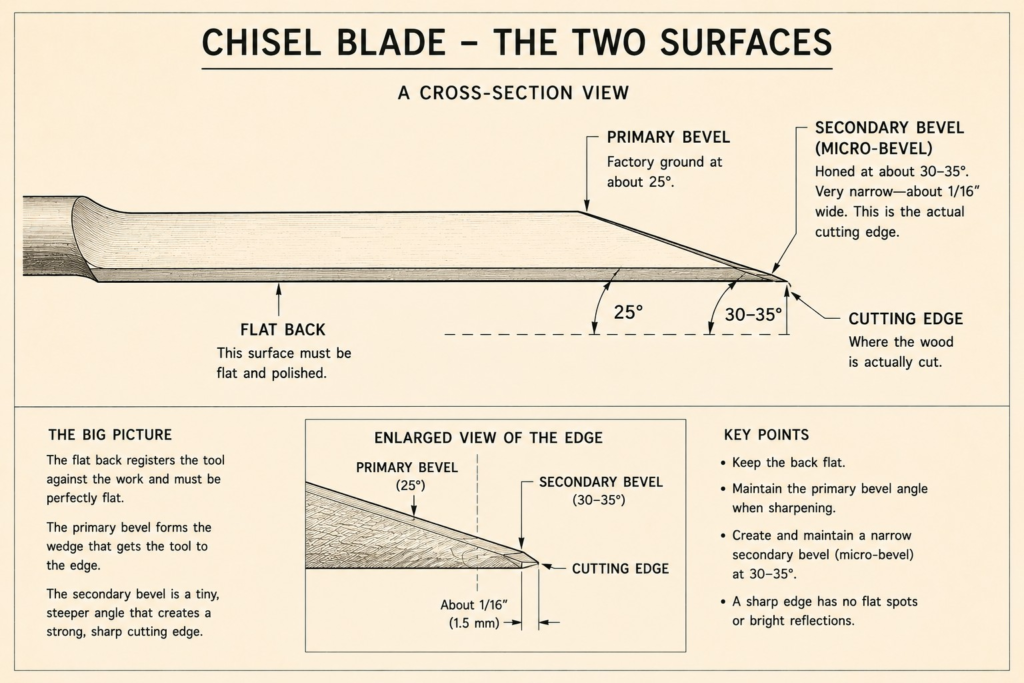
The back of the blade must be flat. When you first get a new tool, spend time on a medium stone flattening the back completely. Hold the blade absolutely flat on the stone — don’t let it rock — and rub it back and forth until the metal shines evenly across the full width near the cutting edge. Do this once well, and you won’t need to repeat it often.
The bevel is the angled face ground onto the cutting end of the blade. Most chisels and plane irons are ground to about 25 degrees at the factory. For the actual cutting edge, you’ll hone a slightly steeper secondary bevel at about 30-35 degrees. This secondary bevel is smaller — only about 1/16 inch wide — but it’s what you’re actually working on every time you sharpen.
Honing the Bevel
Place the bevel flat on your lubricated medium stone. Then lift the handle very slightly — just a degree or two — to bring it up to about 30 degrees. Lock your wrists and rub the blade up and down the length of the stone, maintaining that angle. Move the blade side to side as you work to avoid wearing a hollow in the stone.
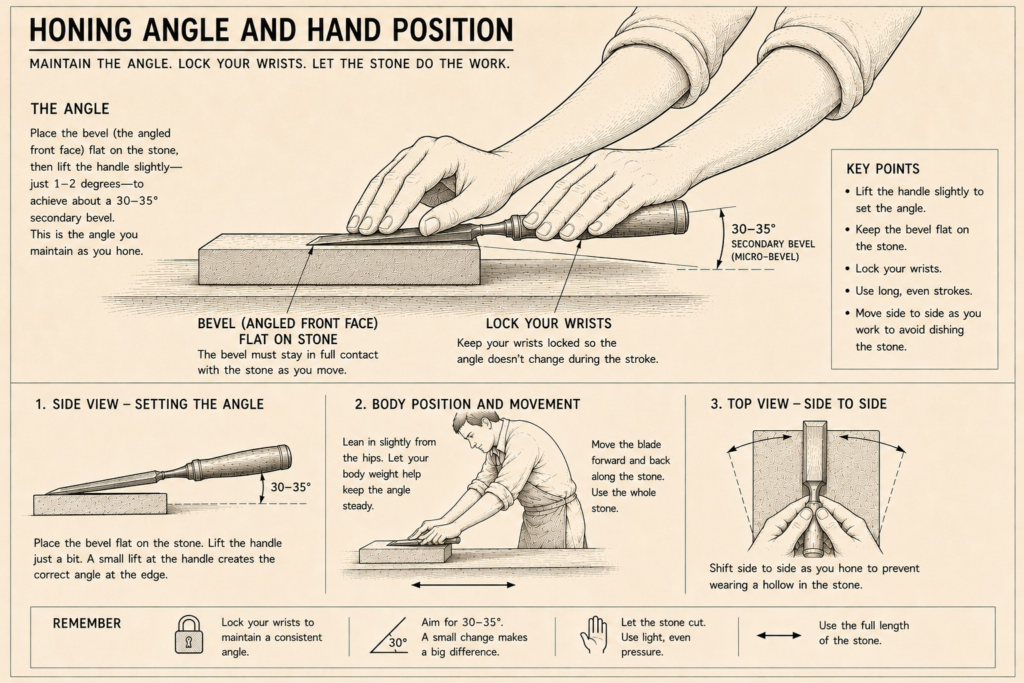
After several strokes, run your thumb very lightly across the flat back of the blade. You’ll feel a small roughness — that’s the burr, a thin sliver of metal raised by the grinding action. The burr means you’ve sharpened all the way to the edge.
Move to the fine stone and repeat. Then lay the back flat on the stone and give it three or four strokes to knock off the burr. Back to the bevel for a few strokes. Strop both the bevel and the back on leather.
Using a Honing Guide
If holding a consistent angle is difficult at first, a honing guide is a simple jig that holds your blade at the correct angle while you move it across the stone. It’s not a crutch — many experienced woodworkers use them because they’re faster and more consistent than freehand honing. Clamp the blade in the guide, set the angle, and roll it across the stone.
Maintaining the Edge
You don’t always need to go through the full sharpening process. When an edge starts to feel slightly less crisp, a few strokes on the fine stone followed by stropping often restores it. The full medium-to-fine progression is for when the edge is genuinely dull or damaged.
Sharpen frequently and proactively. It’s much easier to maintain a good edge than to recover a completely dull one.