Welcome To Part 10 Of Our Series: BUILT BY HAND: A BEGINNERS GUIDE TO HAND TOOLS

Two hand tools that beginners often overlook can save enormous amounts of time and produce results that sandpaper simply can’t match. The cabinet scraper handles flat and nearly flat surfaces. The spokeshave handles curves. Together, they cover finishing work that would otherwise require either extensive sanding or a great deal of patience with a plane.
The Cabinet Scraper
A cabinet scraper is nothing more than a flat rectangle of tempered steel — typically about 2.5 by 5 inches — with a tiny burr turned onto its edges. That burr is the cutting edge, and when it’s properly set up, it shaves wood in thin, continuous ribbons rather than creating dust.
The results are remarkable. A sharp scraper leaves a surface that’s smoother than most sandpaper can produce, with no sanding marks and no torn fibers. On figured or difficult grain that would tear under a plane, a scraper often works beautifully because the burr cuts at a steep angle that handles grain changes well.
Scrapers are also useful for removing dried glue, leveling veneer, and cleaning up small spots without affecting the surrounding surface.
Preparing a Scraper
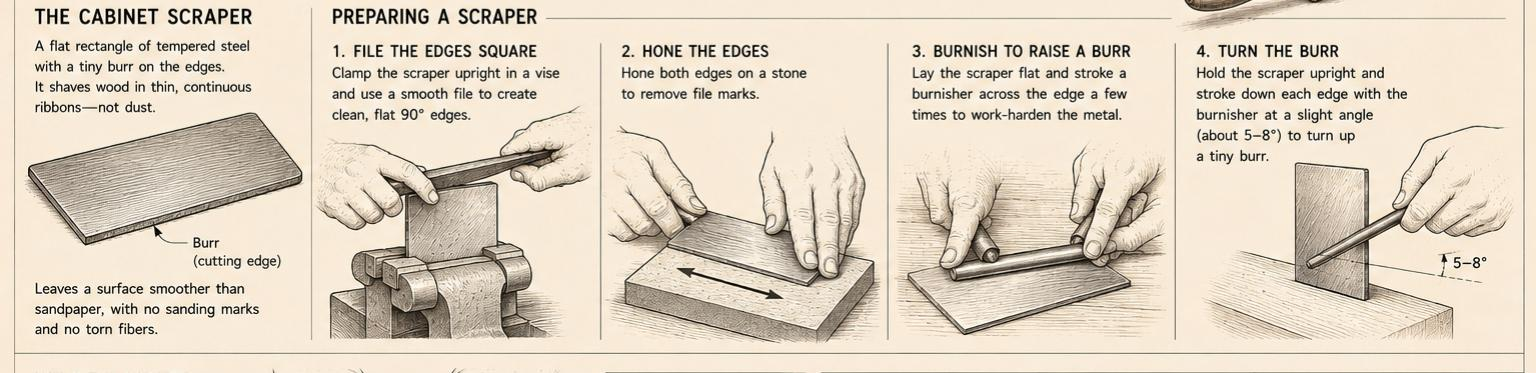
A new scraper comes as a flat piece of steel — it isn’t ready to use yet. You need to create the cutting burr, which is a two-stage process.
First, file the long edges square and flat using a smooth metal file. Clamp the scraper upright in a vise and draw the file along the edge to create a clean, flat 90-degree surface. Then hone those edges on a sharpening stone to remove any file marks. The edge should be flat and polished.
Second, use a burnisher — a hardened steel rod — to turn a burr. Lay the scraper flat on the bench and stroke the burnisher firmly across the edge a few times to work-harden the metal. Then hold the scraper upright and stroke down each edge with the burnisher held at a slight angle (about 5-8 degrees). This turns the edge over into a tiny hook — the burr.
Using the Scraper

Hold the scraper with both hands, thumbs pressing against the center of the face. Flex it into a slight curve by pressing with your thumbs. Tilt it forward to about 60-75 degrees from the surface and push it across the wood. You should get thin, continuous shavings — not dust.
If you’re getting dust instead of shavings, the burr isn’t catching. Try increasing the tilt angle. If the scraper produces a scraping sound and no shavings, the burr is dull and needs to be refreshed. You can turn a new burr a few times before you need to file the edges again.
The scraper will get hot from friction — hot enough to be uncomfortable on your thumbs after a few strokes. Wearing a thin glove on the thumb helps, or you can rest occasionally. Some woodworkers use a scraper plane, which holds the blade in a metal body so you don’t need to hold it directly.
The Spokeshave
A spokeshave is a plane-like tool with a very short sole and two handles extending to each side. The short sole means it can follow curves that a bench plane would bridge over. You push or pull it along curved edges to smooth and shape them.
Spokeshaves come in two common versions: flat-soled (for convex curves, like a rounded edge) and round-soled (for concave curves, like the inside of a curved leg). The flat version is the more versatile of the two and the one to start with.
Using a Spokeshave
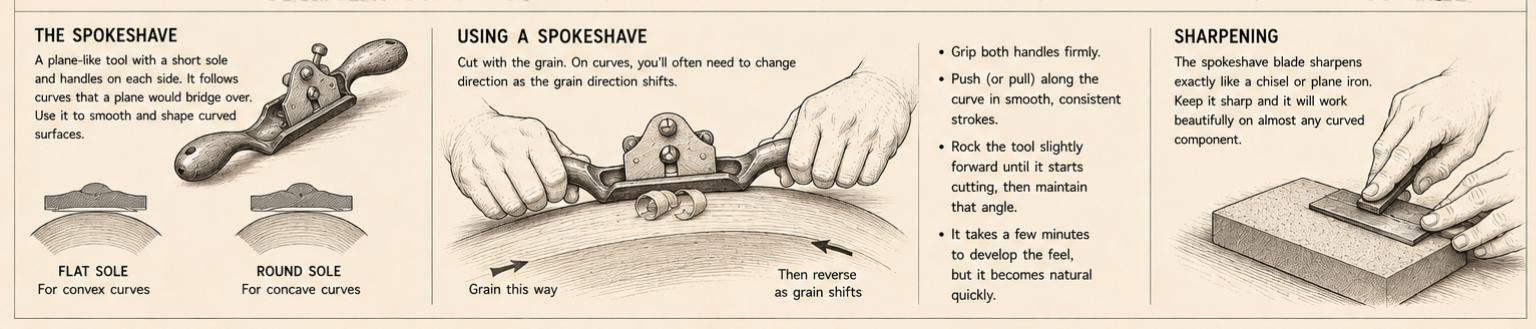
Like a plane, a spokeshave cuts best when moving with the grain. On curved work, this means you’ll often need to change direction as you move along the piece — cutting with the grain one direction, then reversing as the grain direction shifts.
Grip both handles firmly and push (or pull, depending on orientation) along the curve in smooth, consistent strokes. Rock the tool slightly forward until it starts taking a shaving, then maintain that angle. It takes a few minutes to develop the feel, but it becomes natural quickly.
The spokeshave blade sharpens exactly like a chisel or plane iron. Keep it sharp and it’ll work beautifully on almost any curved component — chair legs, table edges, turned parts, shaped rails.