Welcome To Part 8 Of Our Series: BUILT BY HAND: A BEGINNERS GUIDE TO HAND TOOLS
GoTo Part 9
Chisels — Buying, Using, and Not Ruining Them
Chisels are probably the most-used tools in a woodworker’s shop. Mortises, dovetails, hinge recesses, tenon shoulders, joint cleanup — chisels show up in almost every task. Getting comfortable with them, and learning how to maintain them, pays dividends on every project.
Start With Bevel-Edge Chisels
The most useful chisel for general woodworking is the bevel-edge bench chisel. The top edges of the blade are ground at an angle (the bevel), which lets the chisel reach into tight spaces — like the corners of a dovetail joint — that a flat-sided chisel couldn’t reach.
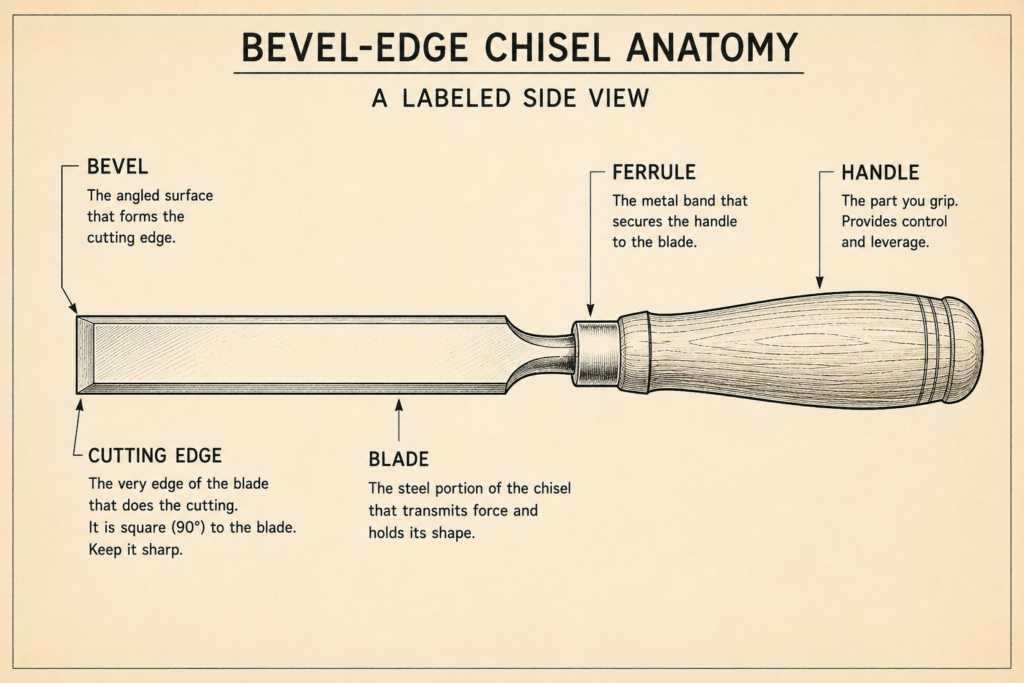
Start with three sizes: 1/4 inch, 3/8 to 1/2 inch, and 3/4 inch. These cover the most common joint sizes and give you flexibility for detailed work. You can add more sizes later as specific needs arise.
Mortise chisels are a different tool entirely — heavier, thicker-bladed, designed for levering out waste from deep mortises without flexing or breaking. If you plan to cut mortise-and-tenon joints regularly, you’ll eventually want at least one, but they’re not where you start.
What to Look For When Buying
The steel is what matters most. Good chisel steel holds an edge longer between sharpenings and takes a sharper edge in the first place. This is where the difference between cheap and quality shows up most clearly.
Handle material matters for feel and durability. Wooden handles have a better feel in the hand but can split if struck repeatedly with a metal hammer. Plastic handles are more durable and can withstand heavier mallet work. Either works fine if you’re using a wooden mallet, as you should be for most work.
The best value in chisels is often found in quality vintage tools. Brands like Marples, Ward, and Stanley made excellent chisels for decades that are still available cheaply at estate sales, flea markets, and online. They typically need sharpening and sometimes handle replacement, but the steel is often better than new budget options.
Using a Chisel Safely and Effectively
Two rules first: always keep both hands behind the cutting edge, and never pare toward your body. A chisel slip with force behind it causes serious injuries. These rules sound obvious, but they’re worth stating explicitly because it’s easy to get careless when you’re focused on the work.
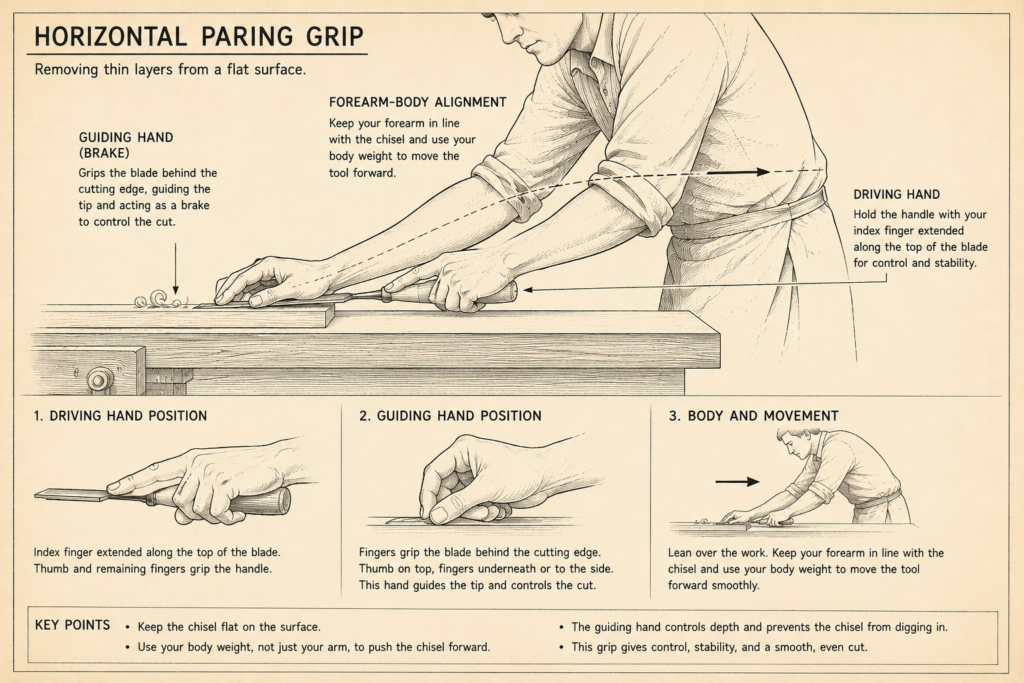
For horizontal paring — removing thin layers from a flat surface — hold the chisel handle with your index finger extended toward the blade. Keep your forearm in line with the chisel and use your body weight to move the tool forward, not just your arm. Your other hand grips the blade behind the cutting edge, guiding the tip and acting as a brake.
For vertical paring — working downward into end grain — hold the chisel vertically with your thumb over the end of the handle. Use your shoulder or chest to apply steady downward pressure.
When to Use a Mallet
Hand pressure is enough for most paring work. When you need to chop — removing significant amounts of waste across the grain, for example — use a wooden mallet.
Strike the end of the handle squarely with the face of the mallet. For heavy chopping, use the full weight of the mallet. For delicate work, hold the mallet near the head and tap lightly. Never use a metal hammer on a wooden chisel handle — it damages the wood and makes the tool uncomfortable to use.
Chopping Mortises
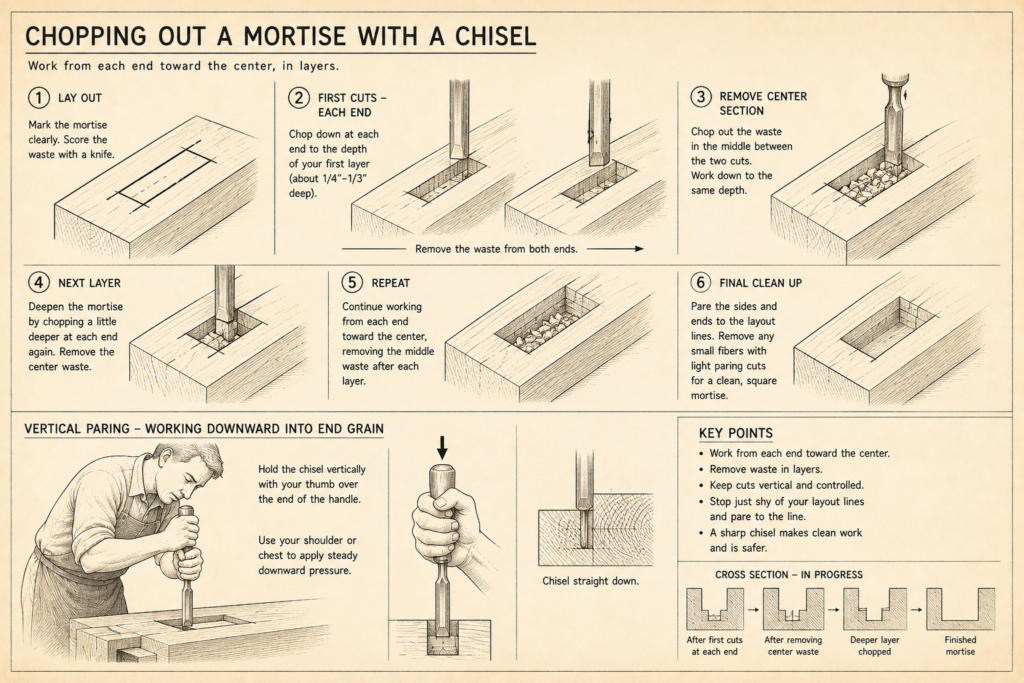
Chopping a mortise is one of the most common heavy chisel tasks. Work from each end toward the center, taking out the waste in layers rather than trying to drive the chisel to full depth at once. Keep the chisel square to the work and lever out the chips as you go. A mortise chisel, with its thick blade, handles this better than a standard bench chisel — the thicker section resists flexing when you lever out the waste.
Storing Chisels
Don’t store chisels loose in a drawer where they knock against each other. Keep them in a canvas tool roll, a wall-mounted rack, or individual blade protectors. Dulled edges from impact in storage are annoying; cuts from reaching into a drawer of loose chisels are worse.
The sharpness rule applies here too: a dull chisel requires more force, which means less control and more risk of the tool slipping unexpectedly. Keep your chisels sharp, and woodworking becomes both safer and more satisfying.