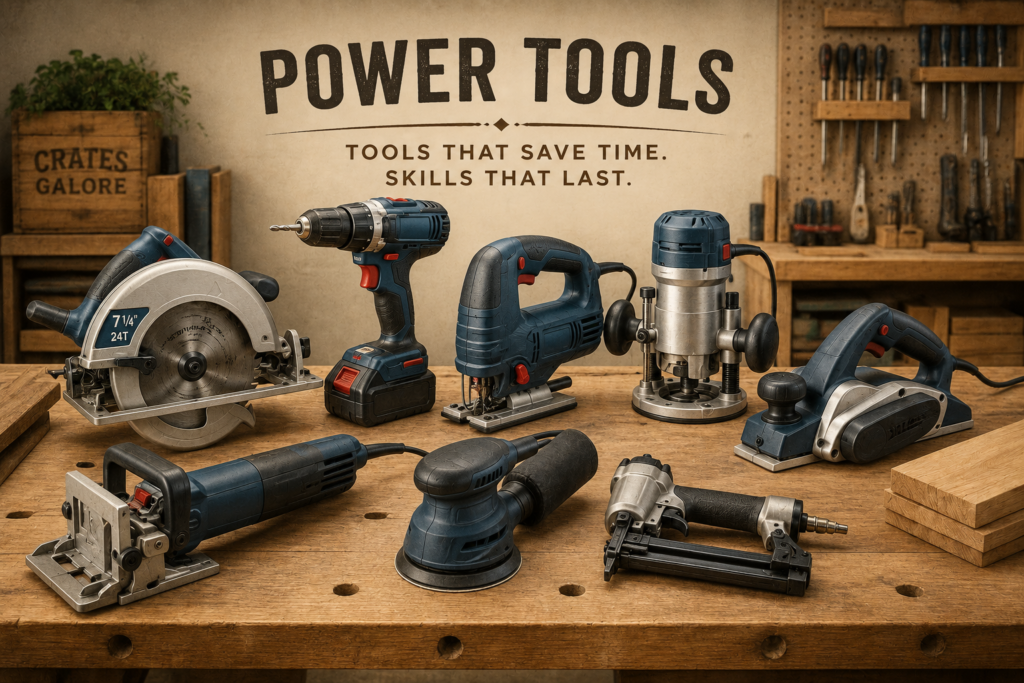
Part 1 of our series: “Tools That Save Time, Skills That Last A Lifetime“
GoTo Part 2
Build a small, versatile foundation—one useful tool at a time.
If you’re just getting started in woodworking, it’s easy to look at all the tools available and wonder how you’re ever going to afford—or even find room for—all of them.
The good news is that you don’t need a shop full of machines to build good woodworking projects.
In fact, buying too many tools too soon can make learning woodworking more complicated than it needs to be. A much better approach is to start with a few versatile power tools that can handle a wide range of jobs. As your skills develop and your projects become more ambitious, you can add specialized tools when you actually have a need for them.
This is the first article in our series on choosing and using basic power tools for woodworking. We’ll look at the tools themselves in much greater detail in the articles that follow. For now, let’s concentrate on building a sensible foundation.
Start With the Essentials
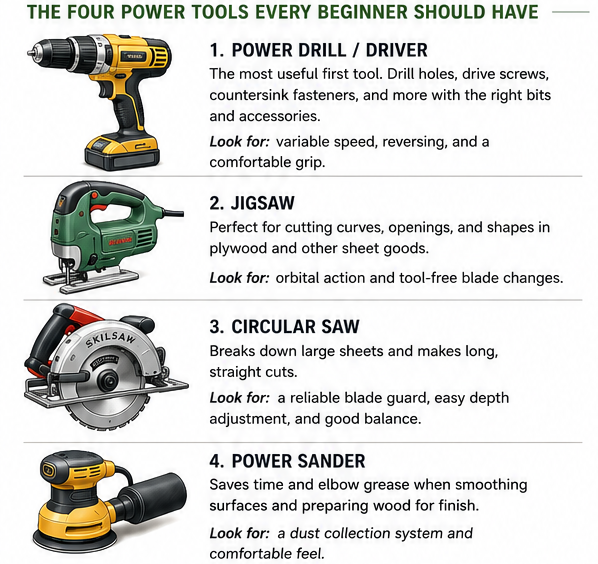
For most beginning woodworkers, four power tools provide an excellent starting point:
- A power drill
- A jigsaw
- A circular saw
- A power sander
These four tools can accomplish a surprising amount.
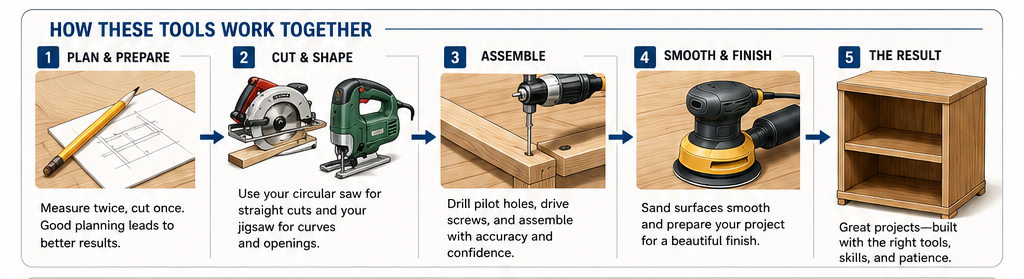
They won’t do everything, of course. No small collection of tools will. But they will allow you to drill, fasten, cut straight lines, cut curves and openings, and prepare surfaces for finishing.
The Power Drill
A power drill is probably the most useful first power tool you can buy.
You’ll use it to drill holes, drive screws, make pilot holes, countersink fasteners, and perform many other jobs with the right accessories.
A cordless drill is particularly convenient for small jobs and screw driving. A corded drill can make sense when you need continuous power.
You don’t necessarily have to choose one or the other. Many woodworkers eventually find that having both types is useful.
We’ll take a much closer look at drills and drill bits in the next article.
The Jigsaw
The jigsaw is the power saw I’d recommend getting to know early.
Its great strength isn’t making long, perfectly straight cuts. It’s making curves, openings, cutouts, and irregular shapes.
A good jigsaw can cut plywood and other sheet goods, and with the appropriate blade it can handle a variety of other materials as well. Its narrow blade allows it to turn where a circular saw simply can’t.
Modern jigsaws are also much easier to control than their older counterparts. Vibration has been reduced considerably, and many models offer orbital action that can increase cutting speed when appropriate.
The important thing is to use the correct blade and avoid forcing the saw through the material.
We’ll cover blade selection, orbital action, curved cuts, plunge cuts, and other jigsaw techniques in a later article.
The Circular Saw
A circular saw is one of the most useful tools you can have in a small shop.
It is particularly valuable when you’re working with plywood, large panels, or lumber that would be awkward to handle on a stationary saw.
Used freehand, a circular saw is primarily a rough-cutting tool. But add a simple straightedge guide and it becomes capable of making remarkably accurate cuts.
This is one of the recurring themes you’ll see throughout this series:
The accessory or technique can be just as important as the tool itself.
A good blade, proper support, and a simple guide can transform the results you get from an ordinary circular saw.
We’ll devote a complete article to using circular saws for woodworking, including straightedge guides, blade selection, cutting depth, sheet goods, and safe cutting practices.
The Power Sander
Sanding is one of those jobs almost every woodworker would happily do without.
Unfortunately, wood doesn’t care.
A power sander can save an enormous amount of time when you’re preparing boards and assembled projects for finishing. But sanding is another area where technique matters more than brute force.
Don’t expect a power sander to do everything. Coarse abrasives remove material quickly, finer abrasives refine the surface, and careful hand sanding is often still necessary for the final preparation.
We’ll explore sanders and sanding techniques in detail later in the series.
What About a Router?

A router deserves an important place in a woodworking shop, but I wouldn’t necessarily put it in the first four tools a beginner buys.
That’s not because a router isn’t useful.
Quite the opposite.
A router is one of the most versatile machines in woodworking. It can cut grooves and dados, shape edges, make rabbets, trim patterns, and perform a wide variety of joinery and shaping operations.
But it also has a steeper learning curve than a drill or jigsaw.
Once you’ve become comfortable with your basic tools, a router is an excellent next step.
And don’t let the tool intimidate you. Beginning woodworkers are often apprehensive about routers because they’re loud and aggressive, but with proper setup and practice they become remarkably versatile tools.
We’ll give routers—and router bits—their own articles later in this series.
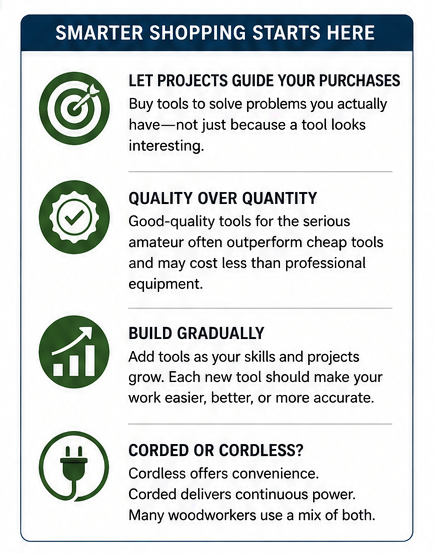
Let Your Projects Guide Your Purchases
There’s a temptation when starting woodworking to buy tools simply because they look interesting.
Try to resist it.
Instead, let your projects tell you what you need.
Suppose your first projects are simple shelves, boxes, or small tables. A drill, jigsaw, circular saw, and sander may be all you need.
Later, perhaps you decide to build cabinets. Now a router or biscuit joiner might solve problems you’re encountering repeatedly.
Maybe you begin working with rough lumber and discover that you’re spending a great deal of time getting boards to the thickness you need. A portable planer suddenly makes much more sense.
That’s a much better way to build a shop than buying every specialized tool you encounter and hoping you’ll eventually find a use for it.
Buy tools to solve problems you actually have.
Your woodworking will tell you what those problems are.
Quality Over Quantity
Does this mean you should buy the cheapest tools you can find?
No.
But it also doesn’t mean you need professional-grade equipment.
Professional tools may be designed for long periods of heavy use, but good-quality tools intended for the serious amateur can often provide excellent performance at a more reasonable price.
When comparing tools, look beyond horsepower and the number of features listed on the box.
Look for:
- comfortable, well-balanced handles;
- controls that are easy to reach;
- accurate adjustments;
- reliable safety guards;
- readily available blades, bits, and accessories;
- useful dust-collection provisions;
- and a reputation for dependable service.
A tool that feels good in your hands and behaves predictably is worth more than one with a long list of impressive specifications that you’ll never use.
Corded or Cordless?
This is one question almost every new woodworker eventually asks.
The answer is: either can be right.
Cordless tools offer tremendous convenience. There’s no power cord to manage, and you can carry the tool wherever you need it. They’re especially handy for drills and other tools used for relatively short periods.
Corded tools have the advantage of continuous power. You don’t have to stop to recharge a battery, and they can be particularly useful for tools that run for extended periods.
The best choice depends on how you work.
And there’s no rule saying your entire shop has to use the same system.
A cordless drill and a corded sander can happily coexist on the same workbench.
Don’t Overlook the Accessories
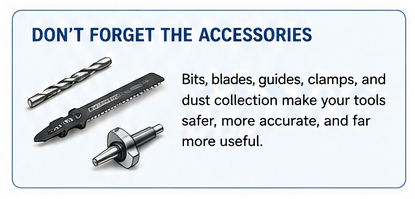
A power tool is only part of the system.
Drill bits determine what your drill can accomplish. Saw blades determine how your saw cuts. Router bits determine what your router can do.
Guides, clamps, stands, dust collection, and other accessories can also make a dramatic difference.
This is why you shouldn’t judge a tool solely by the machine itself.
A modest circular saw equipped with a good blade and a well-made straightedge guide can outperform a much more expensive saw being used carelessly.
Learning how to use the tool is part of the purchase.
Safety Comes First
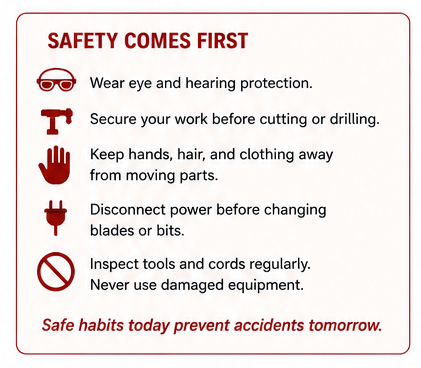
Before we go any further, there’s something more important than choosing the right tool.
Learn to use it safely.
Every power tool in your shop has enough energy to cause a serious injury if it is misused.
The basic rules are simple.
Wear appropriate eye protection whenever your work can produce flying debris. Use hearing protection when working with loud machinery. Keep loose clothing, jewelry, and long hair away from moving parts.
Secure your workpiece rather than trying to hold it in your hand.
Disconnect the tool before changing blades, bits, or other accessories.
Inspect cords and plugs regularly and don’t use damaged equipment.
Keep handles dry and free of grease.
And don’t work in wet or damp conditions.
These aren’t complicated rules, but they’re important ones. Basic safety principles are the foundation of power-tool guidance.
There’s another safety habit that’s worth developing from the beginning:
Think about the cut before you make it.
Where will the blade or cutter go?
Where will the waste go?
Where will your hands be?
What happens if the tool binds?
How is the workpiece supported?
Taking a few seconds to answer those questions can prevent many of the mistakes that lead to accidents.
Build Your Shop Gradually
There’s something satisfying about acquiring woodworking tools.
Most of us enjoy looking at them, learning what they can do, and imagining the projects we might build with them.
But don’t confuse owning tools with becoming a woodworker.
Skills matter more.
A small collection of tools that you understand and use well will take you much farther than a large collection of machines that you barely know how to operate.
Start with the tools that allow you to build the projects you want to build.
Learn them.
Practice.
Make mistakes on scrap.
Then, when you encounter a job that your existing tools don’t handle particularly well, consider whether a new tool would solve the problem.
That’s how a woodworking shop should grow.
One useful tool at a time.
A Sensible Starting Point
If you’re standing in the tool aisle wondering where to begin, here’s a simple starting point:
First: Get a good power drill and a basic collection of bits.
Next: Add a jigsaw for curves, openings, and general-purpose cutting.
Then: Add a circular saw, preferably along with a good blade and a simple straightedge guide.
After that: Add a power sander to make surface preparation faster and easier.
Finally: Let your projects determine what comes next.
A router may be the next logical addition. Or perhaps a biscuit joiner, planer, or another specialized tool will make more sense.
There is no required shopping list.
Your woodworking will tell you what you need.
The Most Important Tool in the Shop

It’s easy to become focused on the machines themselves.
The drill.
The saw.
The router.
The sander.
But the most important tool in your workshop isn’t powered by electricity at all.
It’s you.
Your judgment determines whether a cut is safe. Your patience determines whether the result is accurate. Your willingness to practice determines whether a new tool becomes useful or remains an expensive object sitting on a shelf.
Power tools make woodworking faster.
They don’t replace good decisions.
Start small. Learn the tools you have. Build projects that challenge you without overwhelming you.
And most importantly, enjoy the process.
The rest of the tools can wait.
What’s Next?
In the next article, we’ll take a close look at power drills and drill bits—the first power tool most woodworkers reach for and one of the most useful machines in the shop.