Welcome To Part 5 Of Our 5 Part Series, The Woodworker’s Eye: From Concept to Creation
We’ve journeyed from the initial spark of an idea to the practicalities of lumber selection. You’ve defined the Function, ensured the Structure, drawn the Plans, and chosen your Material. Now, you stand at the threshold of your workshop, ready to bring your design to life.
This final post in our series is about execution. It’s about the tools that become extensions of your hands and the safety protocols that ensure you can keep creating for years to come. A great design is worthless if you can’t build it accurately, and no project is worth an injury.
Let’s explore the essential toolkit for a beginner and the non-negotiable rules of a safe workshop.
1. The Essential Toolkit
You don’t need a shop full of expensive machinery to build beautiful furniture. A small, high-quality collection of hand and power tools is more than enough to get started.
Measure & Mark: The Foundation of Accuracy
As the old saying goes, “Measure twice, cut once.” Your project is only as accurate as your layout lines.
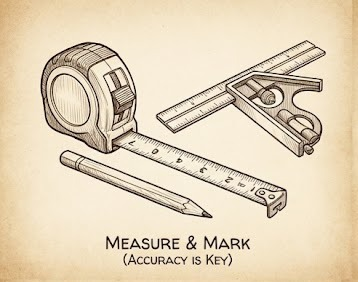
Tape Measure: For rough dimensioning and breaking down large boards.
Combination Square: Your best friend for marking 90-degree and 45-degree angles, checking for squareness, and setting tool depths.
Pencil or Marking Knife: A sharp pencil is good, but a marking knife severs wood fibers, creating a crisp line for your saw or chisel to follow.
Cutting Tools: The “Big Three”
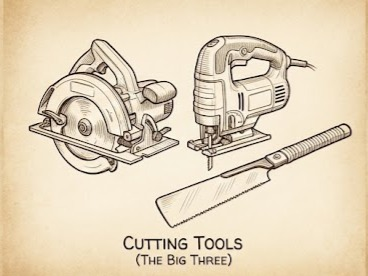
To turn a board into parts, you need to cut it. For most beginners, these three saws cover 90% of cutting tasks.
Circular Saw: The workhorse for breaking down large sheets of plywood and making straight crosscuts or rip cuts.
Jigsaw: The master of curves, circles, and intricate shapes.
Handsaw (e.g., Japanese Pull Saw): Perfect for fine joinery, trimming dowels, and making quick, quiet cuts without setting up a power tool.
Joinery & Assembly
To put it all together, you’ll need a few more items:
- Drill & Driver: For drilling pilot holes and driving screws.
- Chisels: For cleaning up joinery, cutting mortises, and paring wood.
- Clamps: You can never have too many. They are your extra set of hands during glue-ups.
2. Safety First, Last, and Always
Woodworking is a deeply rewarding endeavor, but it involves sharp blades spinning at high speeds. Safety isn’t an afterthought; it’s a core part of the craft.
PPE: The Safety Trinity
Personal Protective Equipment (PPE) is non-negotiable. Every time you enter your shop, you should have these three items on hand.

Eyes (Safety Glasses): Protect your vision from flying dust, chips, and debris. Get a comfortable pair that you won’t be tempted to take off.
Ears (Hearing Protection): Power tools are loud. Prolonged exposure can cause permanent hearing damage. Use earplugs or over-ear defenders.
Lungs (Dust Mask/Respirator): Wood dust is a health hazard, especially fine dust from sanding. A simple N95 mask or a half-face respirator is essential.
A Clean Shop is a Safe Shop
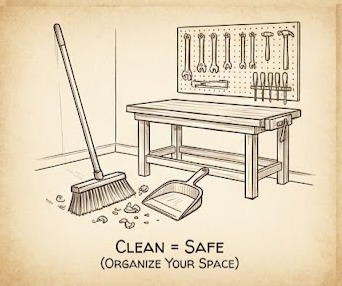
A cluttered workshop is a dangerous one. Trips and falls are among the most common accidents.
Keep Floors Clear: Sweep up shavings and offcuts regularly. Don’t let power cords snake across walkways.
Organize Your Tools: Have a dedicated spot for everything. You shouldn’t have to dig through a pile of sharp tools to find a pencil.
Dust Collection: Use a shop vacuum or a dedicated dust collector to keep airborne dust to a minimum.
Respect the Tool: Sharp is Safer
It may seem counterintuitive, but a sharp tool is much safer than a dull one.
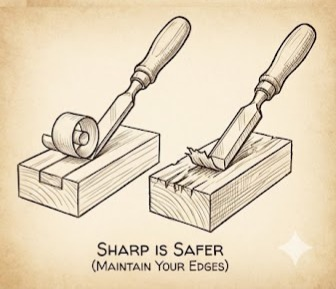
Dull Tools: require more force to cut, increasing the chance of slipping and losing control. They also tear the wood fibers, leading to a messy result.
Sharp Tools: cut cleanly and with less effort, giving you more control over the cut.
Conclusion
You now have the knowledge to take a project from a fleeting thought to a finished piece. You understand function, structure, planning, materials, and the tools to make it happen.
The most important step is the next one: Go build something.
Your first project won’t be perfect. You’ll make mistakes, you’ll waste some wood, and you’ll probably invent a few new swear words. That’s not failure; that’s learning. Every master woodworker started exactly where you are right now.
Embrace the process, respect your tools, and enjoy the incredibly satisfying journey of designing and building with wood.