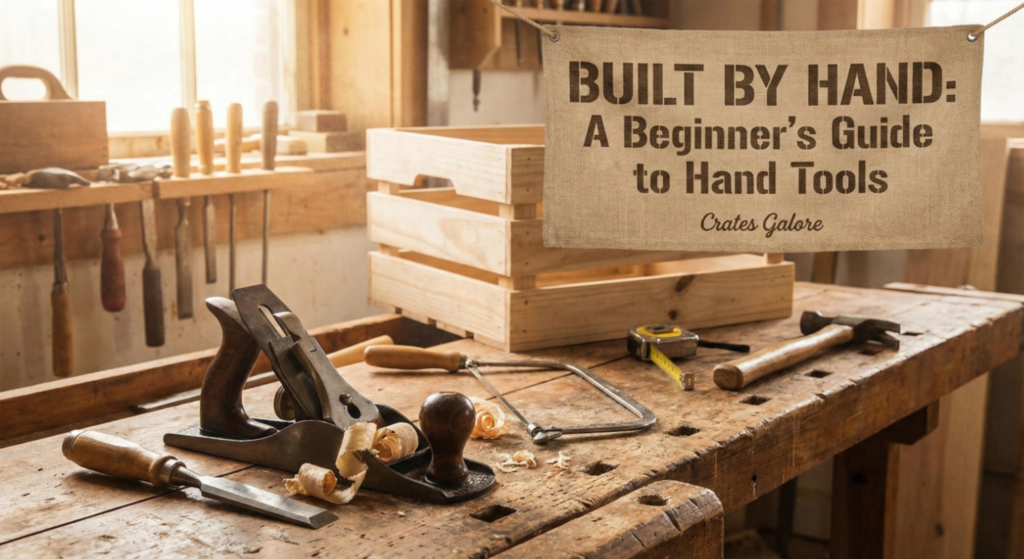
Welcome To Part 6 Of Our Series: BUILT BY HAND: A BEGINNERS GUIDE TO HAND TOOLS
GoTo Part 7
Hand Planes — The Jack Plane Is All You Need to Start
Hand planes intimidate more beginners than almost any other tool. They look complicated, they require sharpening, and there are dozens of types to choose from. Most of that complexity is unnecessary, at least to start. One plane — a well-tuned jack plane with a sharp blade — will handle the vast majority of what you need to do with a bench plane.
Here’s what you actually need to know.
What a Plane Does
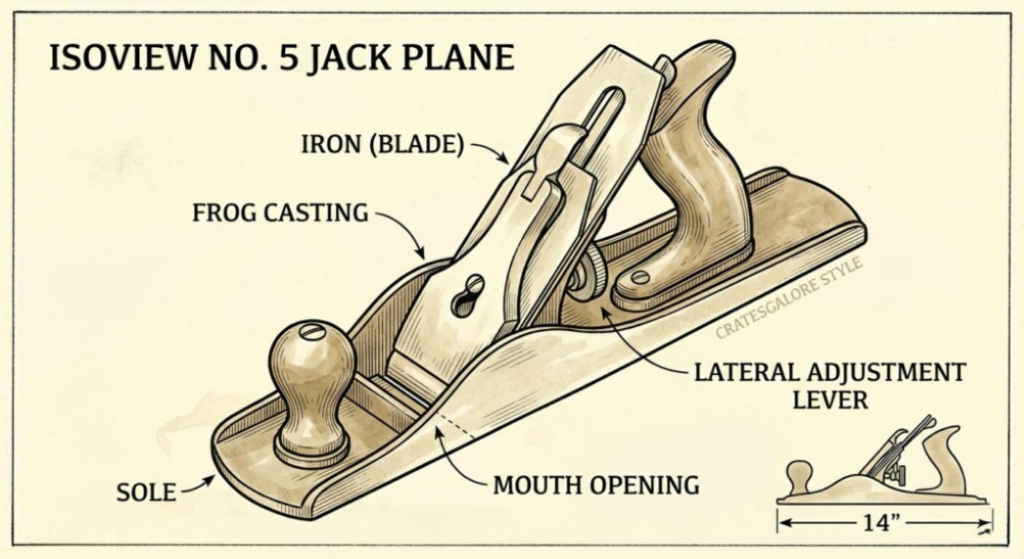
A hand plane is essentially a very precise chisel held at a fixed angle in a body that controls the depth of cut. The blade — called the iron — protrudes slightly through a slot in the flat sole of the plane. As you push the plane across a board, the iron takes a thin shaving, leaving a smooth surface.
You use a plane to flatten boards, smooth surfaces, fit joints, clean up end grain, and put a final finish on wood that’s ready for finishing. A well-tuned plane with a sharp iron leaves a surface that’s often better than anything sandpaper can produce.
The Jack Plane
The No. 5 jack plane is the workhorse of the bench plane family. At 12 to 14 inches long, it’s versatile enough to do rough stock removal, flatten surfaces, and smooth boards — all with the same tool, depending on how you set the blade.
For coarse work, set the blade to take a thick shaving. For smoothing, retract the blade slightly until it just barely protrudes, and you’ll get a glass-smooth surface. This versatility is why experienced woodworkers often say a jack plane is the only bench plane a beginner truly needs.
Tuning Your Plane
A plane fresh from the box — even a good one — usually needs some attention before it performs well. The most important step is sharpening the blade. Plane irons are ground at the factory but not honed, which means they’re not yet sharp enough for fine work. Spend time flattening the back of the iron and honing the bevel before you judge the plane’s performance.
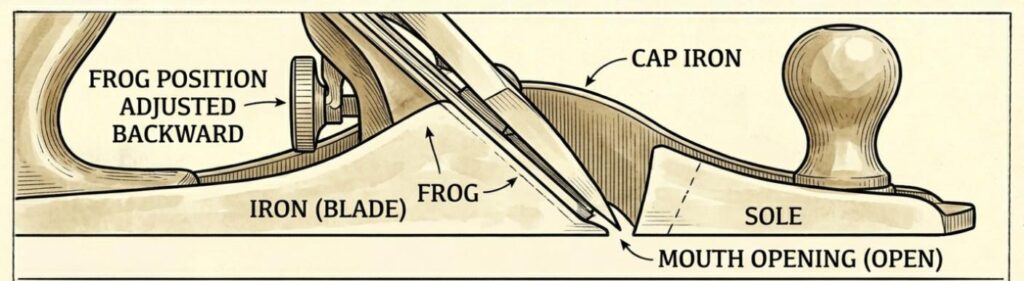
The other key adjustment is the frog — the wedge-shaped casting inside the plane that supports the blade. The frog can be moved forward or backward to change the size of the mouth opening. For fine, smooth cuts, a tighter mouth is better. For coarse material removal, open it up.
Once the blade is sharp and the frog is set, adjust the blade depth by turning the depth-adjustment knob until the iron just barely protrudes. Sight down the sole from the toe (front) of the plane to check that the cutting edge is parallel to the sole. Use the lateral adjustment lever to straighten it if needed.
Using a Bench Plane
Grain direction matters enormously when planing. Look at the edge of your board — the grain lines run at an angle through the thickness of the wood. Plane in the direction that follows the grain upward, not against it. Planing against the grain tears the fibers and leaves a rough surface.
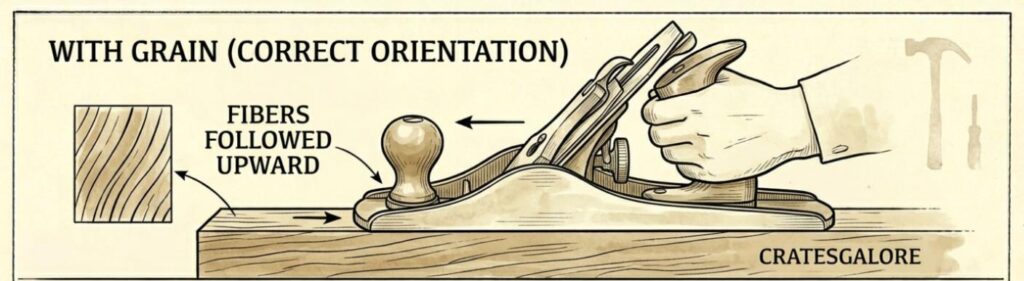
When you start a stroke, put extra pressure on the front of the plane (the toe). As you finish the stroke, shift pressure to the back (the heel). This prevents you from rounding over the ends of the board.
For smoothing a wide surface, work diagonally across the board in two directions first, then finish with strokes running parallel to the edges. Check your progress with a straightedge and look for low spots.
Planing End Grain
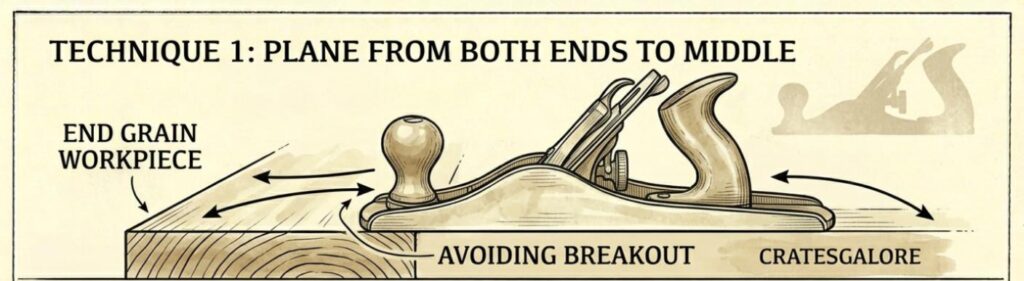
End grain requires a sharper blade and a different technique. Plane from both ends toward the middle to avoid splitting out the far edge, or clamp a scrap block to the far end to support it. A low-angle plane handles end grain more easily than a standard bench plane because of the reduced cutting angle.
What a Plane Won’t Do
A plane works on flat surfaces and straight edges. It won’t follow curves — that’s the spokeshave’s job. It won’t cut grooves or rabbets without specialized versions. For now, just focus on getting comfortable with flat-surface planing and edge work. That alone covers a lot of ground.
The Maintenance Habit
Get in the habit of retracting the blade before setting the plane down, and store it on its side, not on its sole. Keep the sole lightly waxed to reduce friction. Re-hone the blade whenever it starts to chatter or drag — a sharp iron is what makes a plane a pleasure to use.