Welcome To Part 12 Of Our Series: BUILT BY HAND: A BEGINNERS GUIDE TO HAND TOOLS

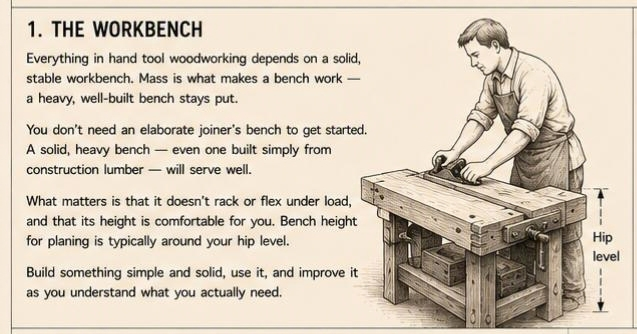
Resist the temptation to spend six months building an elaborate dream bench before you start making anything. Build something simple and solid, use it, and improve it as you understand what you actually need.
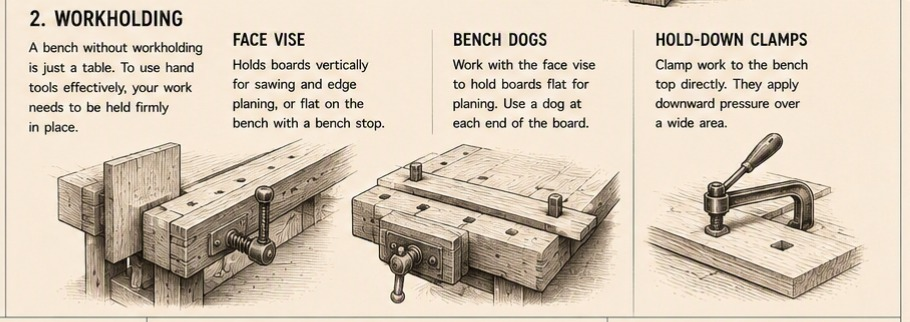
A face vise — mounted on the front of the bench — is the most versatile workholding device. It holds boards vertically for sawing and edge planing, and can hold work flat on the bench with the help of a bench stop. Most woodworking vises use wooden or metal jaws; either works well.
Bench dogs — pegs or stops that fit into holes in the bench top — work with the face vise to hold boards flat for planing. With a dog at each end of a board (one in the vise, one in a hole in the bench), you can plane the full surface without the board moving.
For clamping work to the bench top directly, hold-down clamps that fit into dog holes are useful. They apply downward pressure over a wide area.
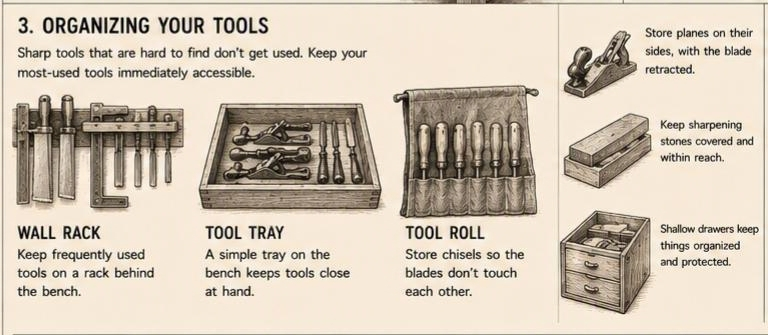
Sharp tools that are hard to find don’t get used. Keep your most-used tools immediately accessible — on a wall rack behind the bench, in a simple tray on the bench top, or in a shallow drawer. The goal is to be able to reach for a chisel or a square without searching.
Store chisels in a tool roll or wall rack where the blades aren’t touching other metal. Store planes on their sides, with the blade retracted. Keep your sharpening stones covered and within reach — the more convenient sharpening is, the more likely you are to do it proactively.
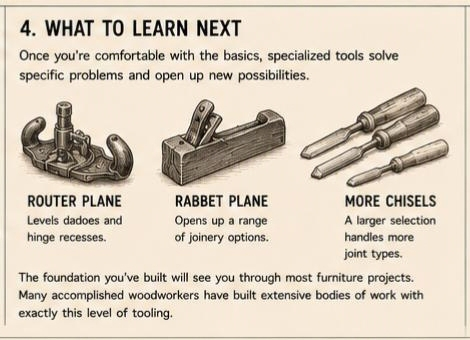
Once you’re comfortable with the tools covered in this series, the natural next steps are the specialized tools that solve specific problems. A router plane for leveling dadoes and hinge recesses is a logical addition — it does things that are difficult to do well with a chisel alone. A rabbet plane opens up a range of joinery options. A larger selection of chisels handles more joint types.
But the foundation you’ve built — a jack plane, a set of bench chisels, a backsaw, measuring tools, and the ability to sharpen them — will see you through most furniture projects without additional equipment. Many accomplished woodworkers have built extensive bodies of work with exactly this level of tooling.
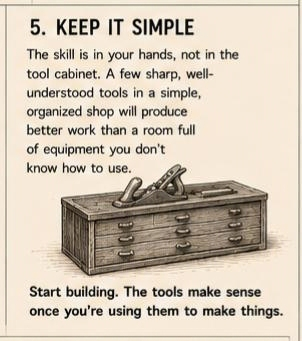
The temptation to collect tools is real and understandable. Good tools are beautiful objects and it’s satisfying to own them. But the actual skill is in your hands, not in the tool cabinet. A few sharp, well-understood tools in a simple, organized shop will produce better work than a room full of equipment you don’t know how to use.
Start building. The tools make sense once you’re using them to make things.
