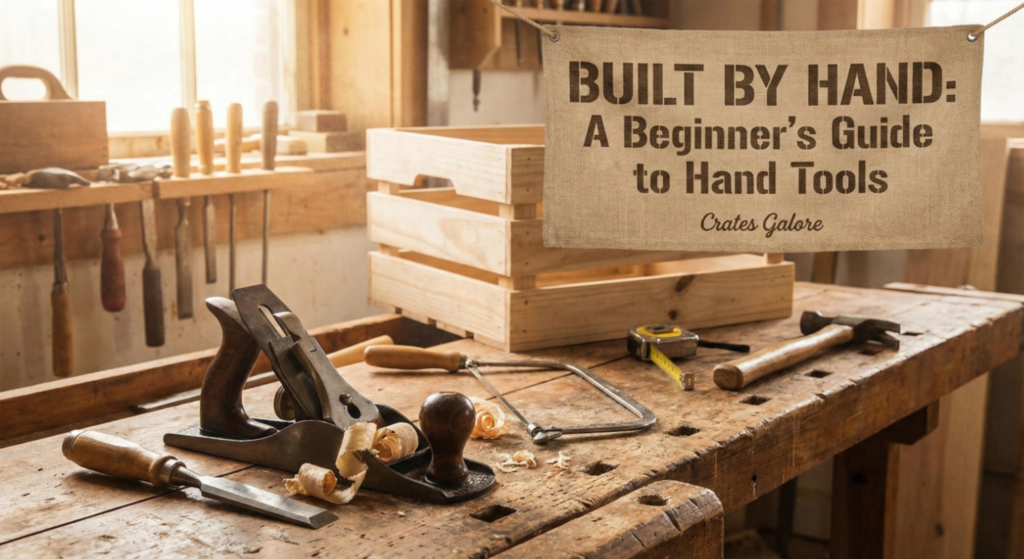
Do You Really Need Hand Tools?
Part 1 of our series: “Built by Hand: A Beginner’s Guide to Hand Tools”
If you’ve spent any time browsing woodworking forums or watching YouTube tutorials, you’ve probably noticed a divide. On one side, there are woodworkers with workshops full of table saws, routers, and jointers. On the other, there are folks cutting dovetails by hand and planing boards without a single electrical cord in sight. If you’re just getting started, you might wonder which camp you belong to — or whether hand tools are even worth your time.
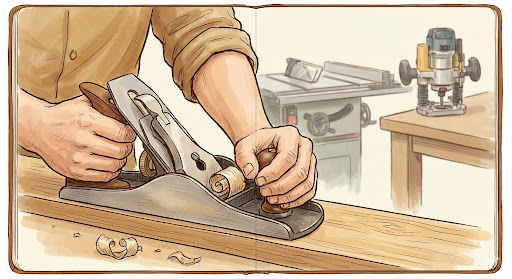
The short answer is yes. Here’s why.
Precision Where It Counts
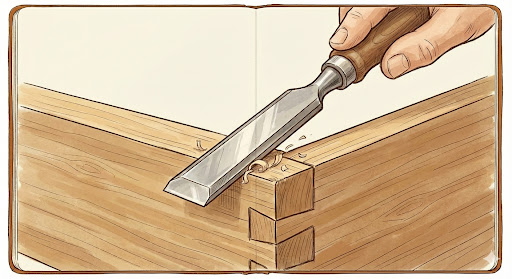
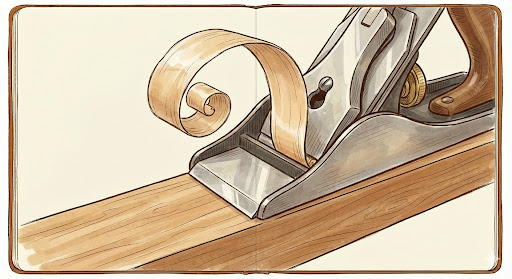
Power tools are fast and consistent, but they’re not always the right tool for fine work. When you’re fitting a joint, trimming a tenon shoulder, or paring a hinge recess, hand tools give you a level of control that a router or power saw simply can’t match. You can take a paper-thin shaving off a piece of wood with a sharp plane. You can sneak up on a perfect fit with a chisel in a way that’s impossible when you’re feeding wood into a spinning blade.
This precision matters most at the joints — the places where two pieces of wood meet. Tight, well-cut joints are the mark of good woodworking, and getting there almost always involves hand tools at some stage.
You Learn the Material
There’s something that happens when you work wood by hand that just doesn’t occur behind a machine. You start to feel how different species behave. Some woods plane like butter; others tear and chip if you go against the grain. Hard maple wants a sharper blade than pine. A freshly cut board responds differently than one that’s had time to dry.
None of this shows up in a spec sheet. You learn it through the tools in your hands. That knowledge makes you a better woodworker across the board — even when you do reach for the power tools.
You Don’t Need a Big Workshop
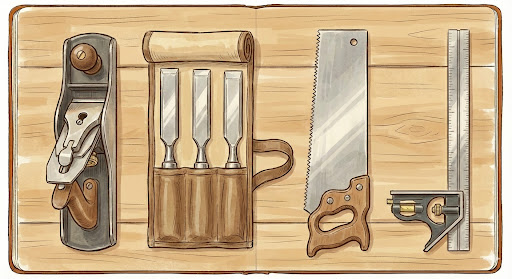
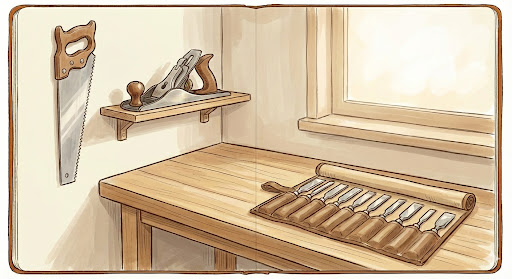
A table saw needs space, dust collection, and enough clearance to feed an eight-foot board through safely. A hand saw, a plane, and a set of chisels can fit in a canvas tool roll. You can work at a solid bench in a spare bedroom, a garage corner, or even outside. The startup cost is lower, the noise is lower, and you can work whenever you want without worrying about waking the neighbors.
For anyone working in a smaller space or on a tighter budget, hand tools aren’t a compromise — they’re genuinely the practical choice.
The Foundation Argument
Here’s the case that experienced woodworkers make most often: learning hand tools first gives you a foundation that makes everything else easier. When you understand how a plane works — how blade angle, grain direction, and sharpness all interact — you understand wood in a way that carries over to every other tool and technique.
You don’t have to give up power tools to use hand tools. Most working woodworkers use both. But if you start with hand tools, you develop an intuition for the material that’s hard to build any other way.
What You Actually Need to Get Started
The good news is that you don’t need a lot of hand tools to do real work. A jack plane, a small set of chisels, a couple of saws, and some measuring tools will get you through the vast majority of projects. We’ll cover each of those in detail in the posts that follow.
The goal of this series is to take you from uncertain about hand tools to genuinely comfortable using them. We’ll cover what to buy, how to use it, and how to keep it sharp. No fluff, no gear collecting for its own sake — just the practical knowledge you need to start building things.
Hand tools have been doing this work for thousands of years. They still earn their place in any serious shop.